Which medical receipts are worth keeping for the tax return
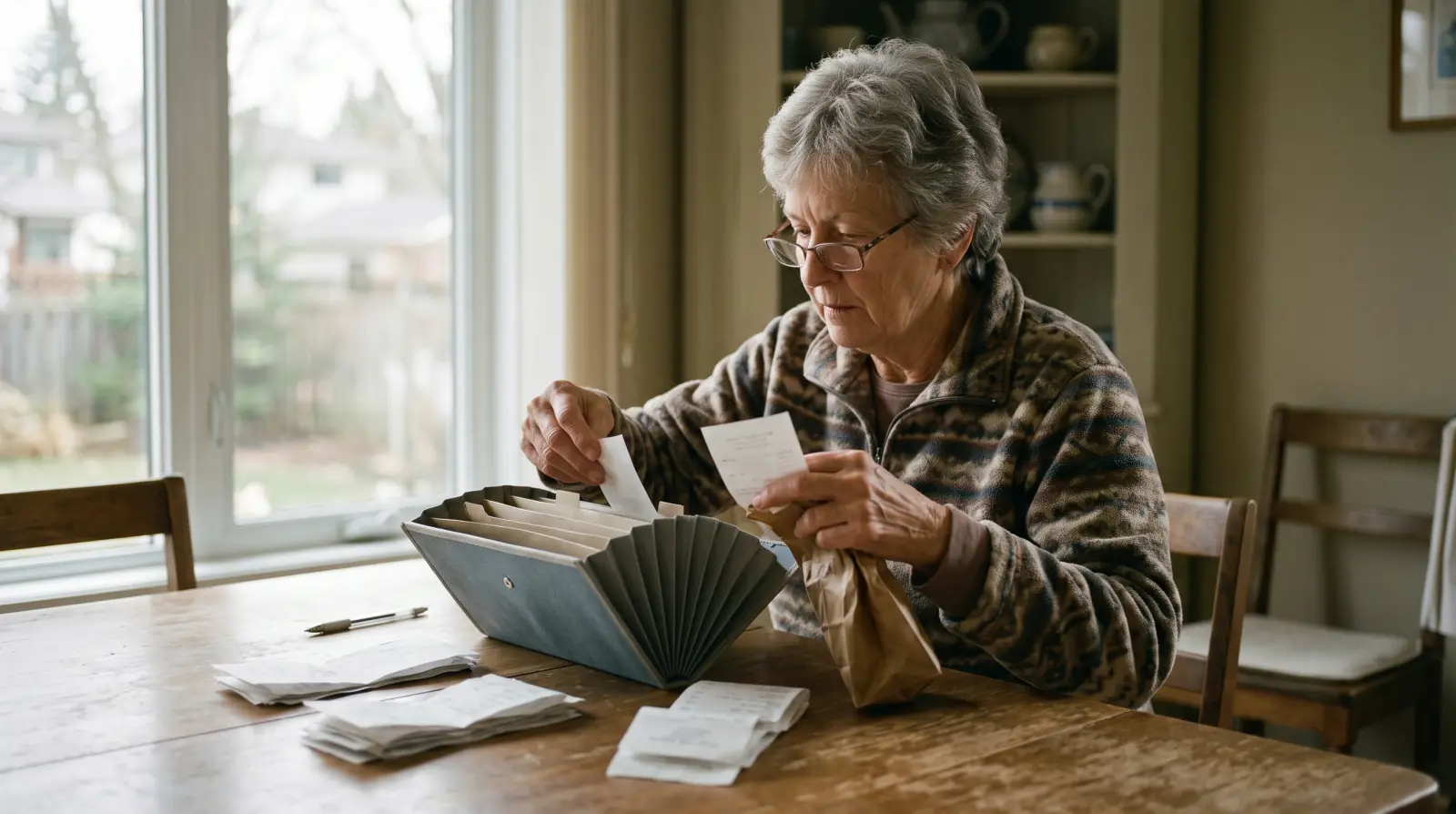
The medical expense credit only starts after a threshold, it runs on any 12-month window you choose, and couples usually do better pooling on one return.
Somewhere in most Canadian homes there is a drawer, an envelope or a shoebox of pharmacy slips and dental receipts. Some of those pieces of paper are worth money at tax time. Many are not. The difference comes down to a threshold, a time window that you get to choose, and the question of whose return they go on.
For retirees the stakes are higher than for most. Health costs tend to rise with age while income becomes fixed, and the medical expense tax credit is one of the few places where the return reflects that.
A credit that starts after a threshold
The medical expense credit does not apply from the first dollar. For the 2025 tax year (the return filed in spring 2026), the Canada Revenue Agency says you subtract the lesser of 3% of your net income or $2,834 from your total eligible expenses. Only the amount above that threshold counts. The fixed dollar figure is adjusted each year.
For most retirees, 3% of net income is the smaller of the two. On a net income of $40,000, the threshold is $1,200; on $60,000, it is $1,800. Anything below that line produces no credit, which is why a year of small receipts often adds up to nothing while a year with hearing aids or dentures can make a real difference.
The credit itself is non-refundable and is calculated at the lowest federal tax rate: 14.5% for 2025 and 14% from 2026, plus a provincial or territorial credit at that jurisdiction's rate. It reduces tax owing; it does not create a refund on its own.
The 12-month window you get to choose
The expenses do not have to fall in the calendar year. The CRA allows a claim for eligible expenses paid in any 12-month period ending in the tax year, as long as they were not claimed the year before. For the 2025 return, that could be January to December 2025, but it could equally be April 2024 to March 2025.
The window matters most when big costs fall either side of New Year. A dental bill in November and hearing aids in March can sometimes be brought into the same 12-month period, which lifts the total well above the threshold in one year rather than leaving two smaller totals that barely clear it.
Which receipts are worth keeping
The CRA's list of eligible expenses is long. These are the ones most common in retirement:
- prescription drugs and insulin;
- dental services and dentures, including the part you pay yourself under a dental plan (see what the Canadian Dental Care Plan covers);
- eyeglasses and contact lenses;
- hearing aids;
- wheelchairs and walking aids;
- fees paid to doctors and other medical practitioners, and laboratory tests.
And these, according to the CRA, are not eligible: gym fees, over-the-counter medications, vitamins and supplements, and organic food. Amounts a plan reimburses you for cannot be claimed either; only the part you actually paid.
Receipts must show the name of the business or person paid. They are not sent with the return, but they should be kept in case the CRA asks to see them. Some items also need a prescription, a written certification from a practitioner, or an approved disability tax credit certificate.
Whose return should carry the claim
On line 33099 you can claim expenses for yourself, your spouse or common-law partner, and your children under 18. Because the threshold is 3% of the claimant's own net income, couples often find that the claim is worth more on the return of the partner with the lower net income, provided that partner has enough tax to use the credit.
Separately, line 33199 covers dependants such as a parent or grandparent who relied on you for support. That calculation uses the dependant's own net income. If you are helping a parent, our piece on the caregiver credit covers a related claim.
A worked example for a couple
| Claimed by Ron | Claimed by Ann | |
|---|---|---|
| Net income | $58,000 | $34,000 |
| Couple's eligible expenses in the chosen 12 months (dental $1,400, hearing aids $2,600, glasses $450, prescriptions $380) | $4,830 | $4,830 |
| Threshold: 3% of net income | −$1,740 | −$1,020 |
| Amount above the threshold | $3,090 | $3,810 |
| Federal credit at 14.5% | $448.05 | $552.45 |
On these figures, putting the same receipts on Ann's return is worth about $104 more in federal credit. Had they spent only $1,500 in the year, Ron would have received nothing and Ann only a little, which is why the timing of the window matters as much as the choice of claimant.
Keep one envelope per 12 months, write the date range on it, and file every receipt that shows a payee name. At tax time, total the envelope, compare it with 3% of each partner's net income, and only then decide whose return it goes on and which 12 months to use.
Who this matters for
- Retirees with one large health purchase in a year: hearing aids, dentures, a mobility device.
- Couples with uneven incomes, where the lower-income partner has tax to reduce.
- People who travel for treatment or winter away and pay costs out of pocket; see how provincial health coverage works when you are abroad.
- Working retirees whose tax situation changed; see part-time work at 62.
The receipt that counts
Not every pharmacy slip is worth keeping, but the ones that are can add up to a real reduction in tax. The rule of thumb: keep anything for prescribed treatment, dental work, vision and hearing with the payee's name on it, choose your 12 months deliberately, and run the numbers on both partners' returns before filing. The official list on Canada.ca is the final word on what qualifies.
Official sources
- Canada Revenue Agency: lines 33099 and 33199, eligible medical expenses · the 12-month period, the 3% or $2,834 threshold for 2025, eligible and ineligible items, receipts
- Canada Revenue Agency: current year tax rates and income brackets · lowest federal rate of 14% for 2026
- Department of Finance Canada: lowest tax rate and non-refundable tax credits · credit rate tied to the lowest rate: 14.5% for 2025, 14% from 2026
About this article. This is private sponsored information published by FinanceAdvice OÜ under the Saude Animal name. It is not a Government of Canada, Service Canada or Canada Revenue Agency website or publication and has no affiliation with any government body. Nothing here is financial, tax, legal or medical advice, and no figure is a promise, quotation or entitlement for any reader: every example is illustrative, and amounts and rules depend on personal circumstances and change over time. Figures were checked against the official sources listed above on . There are no applications and no fees on this website. Never give your Social Insurance Number, banking details or My Service Canada Account / CRA sign-in details to a website in response to an article. For your own payments and records, use My Service Canada Account or contact Service Canada directly.



 Pensions