
What the Canadian Dental Care Plan covers for seniors, and what it doesn't
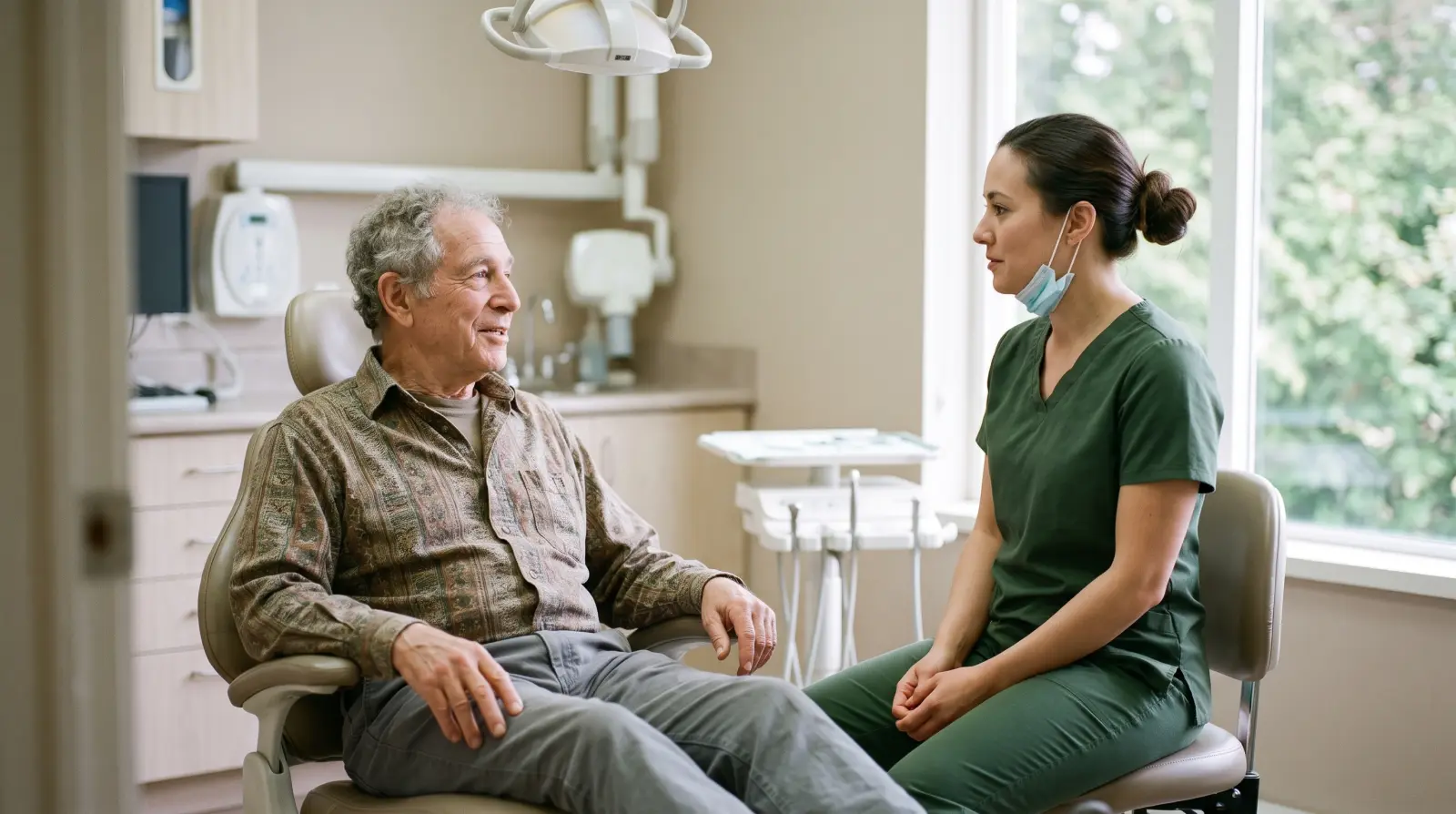
Cleanings, fillings and dentures are on the list. Orthodontics, extra charges above the plan's fees and some pre-approved work are where the surprises sit.
For many people, dental insurance ends the day work ends. The cleanings carry on, the crowns from forty years ago start to give out, and the bills arrive at exactly the moment the household has switched to a pension income. The Canadian Dental Care Plan was created for that gap. It is a real help for a great many retirees, but it is not the same as the plan they had at work, and the differences show up at the dentist's counter.
Here is what the plan covers, who it is for, what it leaves to the patient, and how the official application works.
Who the plan is for
The Government of Canada lists four requirements, and an applicant has to meet all of them:
- Adjusted family net income below $90,000. This is based on the family net income from the tax return (line 23600), with a few adjustments for specific benefit amounts.
- No access to dental insurance or coverage. Not through a job, a pension plan, a spouse's or family member's plan, a professional or student association, and not through a policy bought privately.
- A tax return filed in Canada for the previous year, by the applicant and by a spouse or common-law partner if there is one.
- Canadian residence for tax purposes.
The insurance condition is the one retirees trip over most. Having access to coverage is enough to be ineligible, even if you choose not to use it. There is one notable exception: retirees who opted out of dental coverage through their pension plan before 11 December 2023 and cannot opt back in. Someone who opted out after that date is not eligible. Eligibility also has to be reconfirmed every year.
What is covered
The plan covers a broad list of oral health care when it is recommended by a provider:
- Diagnostic and preventive care: examinations, x-rays, cleanings, fluoride and sealants.
- Basic restorative care: fillings, root canal treatment and non-surgical gum care.
- Major care: crowns, complete and partial dentures, and oral surgery such as extractions.
- Anesthesia and sedation in the forms listed by the plan.
For older adults, the inclusion of dentures and crowns is the significant part. These are the expensive items that a retirement budget struggles to absorb.
What isn't covered, or only partly
Four limits are worth knowing before an appointment.
Orthodontics. The plan currently states that orthodontic services are not available.
Fees above the plan's grid. The plan pays according to its own established fees, and the Government of Canada notes plainly that these may not be the same as what a provider charges. If the dentist's fee is higher, the patient pays the difference directly.
Services outside the plan. Anything the patient and provider agree on that the plan does not cover is paid by the patient.
Work that needs approval first. Some services, including crowns, partial dentures, complete immediate dentures and overdentures, root canal re-treatment and some forms of sedation, require preauthorization. The plan says that not all requests will be approved. Treatment carried out before approval can end up being paid in full by the patient.
The co-payment, by income
On top of any fee difference, most patients with family incomes above $70,000 share the cost of covered care:
| Adjusted family net income | Plan pays | Patient co-pays |
|---|---|---|
| Under $70,000 | 100% | 0% |
| $70,000 to $79,999 | 60% | 40% |
| $80,000 to $89,999 | 40% | 60% |
A worked example with a partial denture
Take an illustrative retired couple with an adjusted family net income of $76,000, one of whom needs a partial denture. The dental office charges $1,500. Suppose, purely for the example, that the plan's established fee for the same work is $1,300.
The plan pays 60% of its $1,300 fee: $780. The couple pays the 40% co-payment of $520, plus the $200 by which the office's fee exceeds the plan's fee: $720 in total. With a family income under $70,000, the co-payment would disappear and the couple would pay only the $200 difference.
Both fees are invented; the real established fees vary by service and province. Ask the office for a written estimate showing the plan amount and your share before treatment starts.
The amount a patient pays out of pocket for eligible dental services can usually be counted toward the medical expense tax credit, while amounts reimbursed by a plan cannot. Our article on which medical receipts are worth keeping explains the threshold and the 12-month window.
How the official application works
Applications are made only through the Government of Canada. The official routes are:
- online through My Service Canada Account, in the Canadian Dental Care Plan section;
- online through the application page on Canada.ca, for people who cannot use the account;
- by telephone with Service Canada at 1-833-537-4342 (TTY 1-833-677-6262).
A spouse or common-law partner applies separately. The application asks for personal details including the Social Insurance Number, which is exactly why it should only ever be given through those official channels. No website, including this one, can apply on your behalf, speed up a decision or "unlock" coverage, and no legitimate route charges a fee.
Who should look at this, and what to check
- New retirees who lost workplace dental coverage. Check carefully whether your pension plan still offers dental coverage you could join; access alone rules you out.
- Households near $70,000 or $90,000. The tier depends on adjusted family net income from the previous year's return, so a one-off RRSP withdrawal can move you up a tier.
- Anyone planning major work. Ask about preauthorization and the gap between the office fee and the plan fee before the appointment.
- Family caregivers. If you help a parent with appointments, see what the caregiver credit is worth as well.
The useful summary
The Canadian Dental Care Plan covers most of the care older adults actually need, including dentures and crowns, for people without other dental coverage and with adjusted family incomes under $90,000. What it does not do is guarantee a free visit: co-payments apply above $70,000, providers can charge more than the plan pays, and some treatment needs approval first. Asking for an itemized estimate is the simplest way to know the real cost in advance.
Official sources
- Government of Canada: Canadian Dental Care Plan, do you qualify · the four requirements and the pension opt-out date of 11 December 2023
- Government of Canada: Canadian Dental Care Plan, what is covered · covered services, co-payment tiers, preauthorization, fees above the plan
- Government of Canada: apply for the Canadian Dental Care Plan · official application routes and telephone numbers
About this article. This is private sponsored information published by FinanceAdvice OÜ under the Saude Animal name. It is not a Government of Canada, Service Canada or Canada Revenue Agency website or publication and has no affiliation with any government body. Nothing here is financial, tax, legal or medical advice, and no figure is a promise, quotation or entitlement for any reader: every example is illustrative, and amounts and rules depend on personal circumstances and change over time. Figures were checked against the official sources listed above on . There are no applications and no fees on this website. Never give your Social Insurance Number, banking details or My Service Canada Account / CRA sign-in details to a website in response to an article. For your own payments and records, use My Service Canada Account or contact Service Canada directly.




 Everyday money