How to help grown children financially without weakening your own retirement
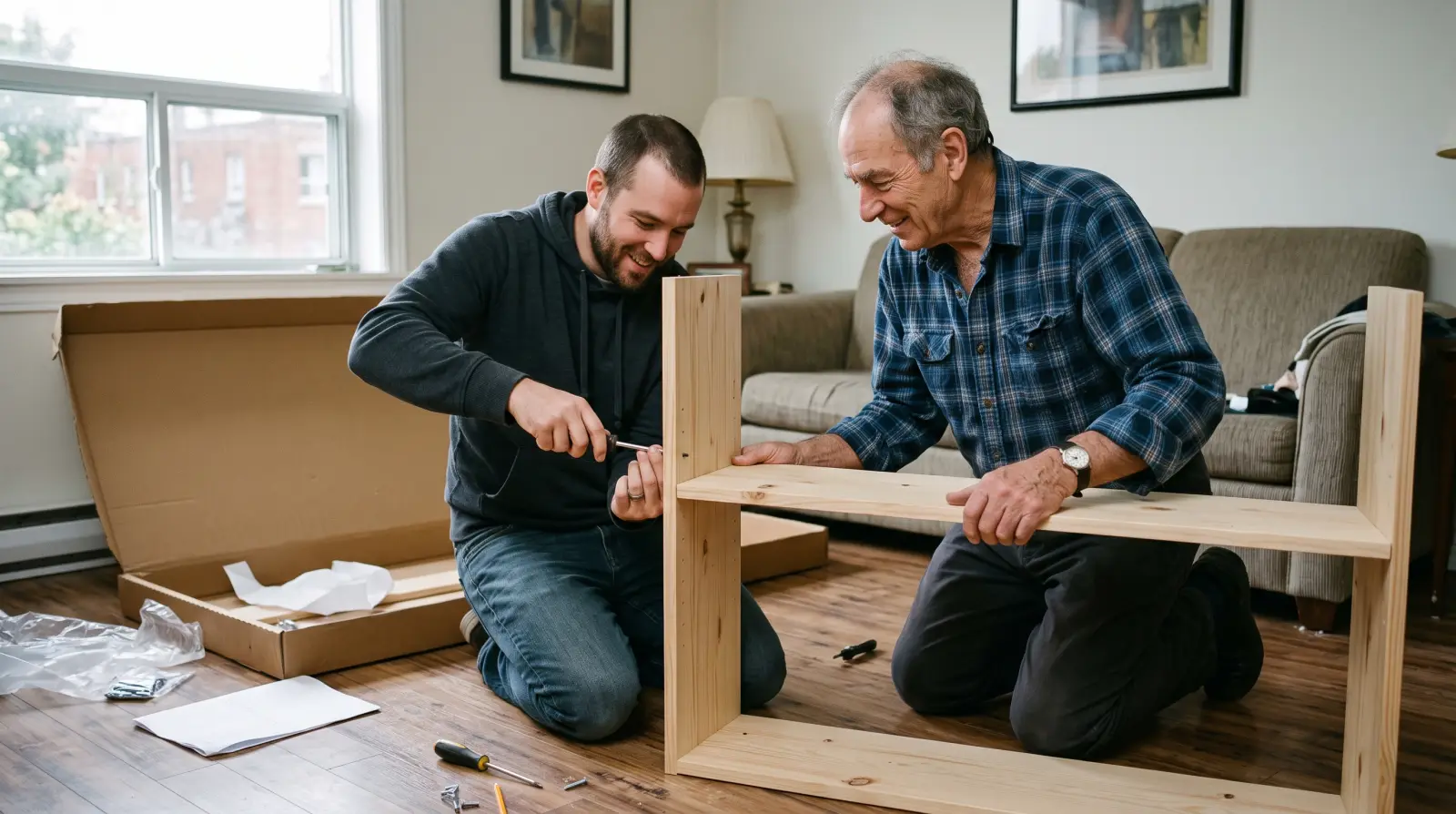
Canada has no gift tax, but a gift still has a source. Where the money comes from, whether it is a gift or a loan, and what that does to next year's pension income.
It usually starts with a phone call. A down payment that is just out of reach, a rent increase, a car that has finally given up. For parents in their sixties and seventies, helping a grown child is one of the most natural uses of money there is. It is also one of the easiest ways to weaken a retirement without noticing, because the gift happens once and its effects show up later, quietly, in the monthly budget.
This is not an argument against helping. It is a look at the three questions that decide how much a gift really costs the giver: where the money comes from, whether it is a gift or a loan, and what it does to the savings that the pension was relying on.
Canada has no gift tax, but a gift still has a source
Canada does not levy a separate tax on gifts between family members, and a cash gift is not income to the child who receives it. What can create tax is the way the giver raises the money. Cash from a chequing account costs nothing extra. Cash from an RRSP or RRIF is taxable income to the person who withdraws it. And giving investments directly, rather than cash, has its own rule: the Canada Revenue Agency says that when you give capital property as a gift, you are considered to have sold it at its fair market value at that moment, and any capital gain is reported on your return for that year.
Where the money comes from changes the real cost
Take an illustrative retired couple who want their daughter to receive $40,000 toward a first home. Here is how the same gift looks from three different sources.
| Source of the $40,000 | Tax at the time | Effect on next year |
|---|---|---|
| TFSA withdrawal | None; withdrawals are not taxable | The $40,000 of contribution room returns on 1 January of the following year |
| Selling non-registered investments | Capital gain or loss on the units sold, reported that year | Lower investment income in future years |
| RRSP or RRIF withdrawal | 30% withheld at source: $12,000 of a $40,000 withdrawal. To hand over a full $40,000, about $57,150 has to come out | The whole withdrawal is added to that year's taxable income, which can affect income-tested benefits |
The RRSP line is the one that surprises people. Withholding is only an advance on the final tax, which is settled on the return, but the extra income can also reach the Old Age Security recovery tax, which applies to net world income above $95,323 for the October to December 2026 period, and it reduces the Guaranteed Income Supplement for those who receive it. A gift that looks like $40,000 can cost the giver noticeably more. Our article on bridging-year budgets explains how withdrawals and pensions interact.
Gift or loan?
Some parents prefer to lend rather than give, either to be repaid one day or simply to keep the arrangement clear among several children. A loan should be written down: the amount, whether interest is charged, and when or whether it is to be repaid. How a family loan is treated in a separation or in an estate depends on provincial law, so a short conversation with a lawyer is worthwhile for larger amounts.
There is also a tax angle. The attribution rules in the Income Tax Act mainly concern spouses and children under 18. A separate rule can apply to low-interest or interest-free loans between family members who do not deal at arm's length, where one of the main reasons for the loan is to reduce tax; the income earned on the loaned money can then be taxed in the lender's hands. A gift of cash to an adult child to help with a home is a different situation, but anyone structuring a loan so that the child invests the money should ask a tax professional first.
Money given to a spouse or common-law partner and invested is generally subject to attribution, but the CRA makes a specific exception: you may give your spouse money to contribute to their own TFSA, and neither the amount nor the income it earns is attributed back to you. The TFSA dollar limit for 2026 is $7,000, plus any unused room.
The retirement test: what the gift does to the runway
The tax is only part of the cost. The larger part is what the money would otherwise have done. Suppose, again for illustration, the couple draws $1,000 a month from $300,000 of savings to top up their CPP and OAS.
| Savings | Months at $1,000 | Years | |
|---|---|---|---|
| Before the gift | $300,000 | 300 | 25.0 |
| After a $40,000 gift from a TFSA | $260,000 | 260 | 21.7 |
| After the same gift funded from an RRSP | about $242,850 | about 243 | about 20.2 |
Nothing in that table is dramatic. It simply makes visible that the gift shortens the period over which savings top up the pensions by somewhere between three and five years, depending on where it comes from. For a couple in their mid sixties, whose savings may need to last into their nineties, that is worth knowing before the money moves.
Ways to help that weigh less
- Smaller, regular help from monthly income rather than one large withdrawal.
- Timing a larger gift for a year in which other taxable income is low.
- Help in kind: childcare, a room for a while, practical help with a move. These cost time rather than capital.
- Releasing money from the house instead of savings. Our articles on what downsizing actually frees up and what a reverse mortgage costs over ten years show both routes with their full costs.
Who this matters for, and what to check
Parents considering a gift or loan of a size that would be noticed in their own budget should check four things before agreeing an amount: which account the money would come from, the tax effect of that source this year, whether it touches OAS or GIS, and how many years of savings it represents. If one parent still works part-time, the tax on that income belongs in the same calculation.
The generous answer and the safe answer
They are usually the same answer, approached in the right order. Decide first what the household needs for its own retirement, then what can be given, and only then from which account. Canada's lack of a gift tax makes helping family simple on paper; the source of the money and the years of savings it represents are what make it expensive or affordable in practice.
Official sources
- Canada Revenue Agency: Capital Gains guide (T4037) · gifted capital property is considered sold at fair market value
- Canada Revenue Agency: tax rates on RRSP withdrawals · withholding of 10%, 20% and 30% outside Quebec
- Canada Revenue Agency: how to contribute to a TFSA · gifts to a spouse for their TFSA are not attributed; $7,000 limit for 2026
- Canada Revenue Agency: interspousal and certain other transfers and loans of property (IT-511R, archived) · attribution rules and low-interest loans between related individuals
About this article. This is private sponsored information published by FinanceAdvice OÜ under the Saude Animal name. It is not a Government of Canada, Service Canada or Canada Revenue Agency website or publication and has no affiliation with any government body. Nothing here is financial, tax, legal or medical advice, and no figure is a promise, quotation or entitlement for any reader: every example is illustrative, and amounts and rules depend on personal circumstances and change over time. Figures were checked against the official sources listed above on . There are no applications and no fees on this website. Never give your Social Insurance Number, banking details or My Service Canada Account / CRA sign-in details to a website in response to an article. For your own payments and records, use My Service Canada Account or contact Service Canada directly.

 Home

 Pensions